

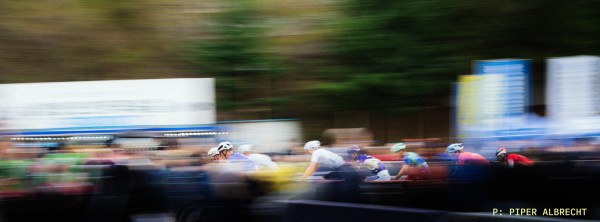
This year the season began with the first ever XC World Cup in Asia. Far from the comfort of the European mainland, riders arrived at the much anticipated venue of Mona YongPyong, South Korea. Like all fledgling World Cup venues, there were some growing pains – both from the venue hosting a race in a country where participation in mountain bike riding is too low to even rank in the national sports participation ranking, and from the teams as they learned to operate without Google Maps or the English Alphabet.
Two-hundred kilometers east of Seoul, the venue was home to the 2018 Winter Olympics. Whilst it may be a lively ski town in winter, it becomes a ghost town when the snow melts. The town is spread far enough apart that even during the event the atmosphere in the village was quiet. Despite heavy skepticism about how many fans would show up, come race day the course was far from quiet, with fans coming from both Korea and internationally. Whilst many were not the traditional mountain bike fans, they were just as enthusiastic – especially for the riders who did wheelies. In many ways it is nice to see the sport through the eyes of people who have never watched a MTB race before.
XCC
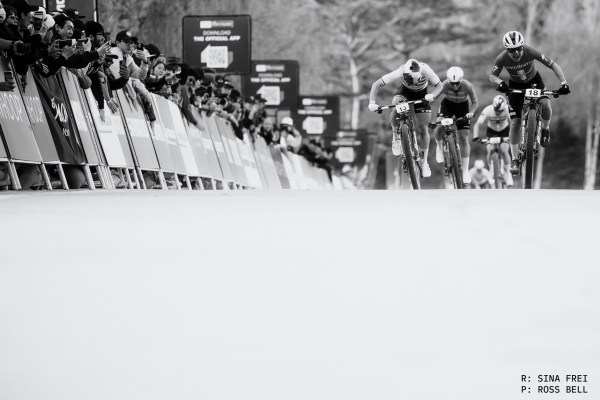
In the women’s XCC as Sina Frei edged out Evie Richards and Martina Berta by just one second. Sina’s teammate Laura Stigger finished in fourth after repeatedly moving to the front and lifting the pace on the climb to string the field out through the dusty, low-grip sections.
In the men’s race, despite repeated accelerations on the punchy climb, no move was allowed to stick. The wide layout and fast transitions encouraged aggression, yet the loose, dusty surface and low visibility discouraged risk. Mathis Azzaro read it perfectly, edging out Simone Avondetto and Dario Lillo by just two seconds. Notably, both elite races ran around four minutes over target time.
Despite the course being labelled as ‘not technical’ and ‘kind of boring’, there were a multitude of crashes even in the dry, especially for the Americans. Haley Batten and Björn Riley were taken out by the same tree in the XCC, and last season’s overall winner, Christopher Blevins, crashed in course practise and was left without a single scratch, but with a broken collarbone.

XCO
Like most World Cup courses held on ski fields, riders had the pleasure of ascending steep ski slopes. Like most World Cup courses run for the first time, the descents started as delicious fresh loam, that quickly became dust, and then unridable mud in the rain.
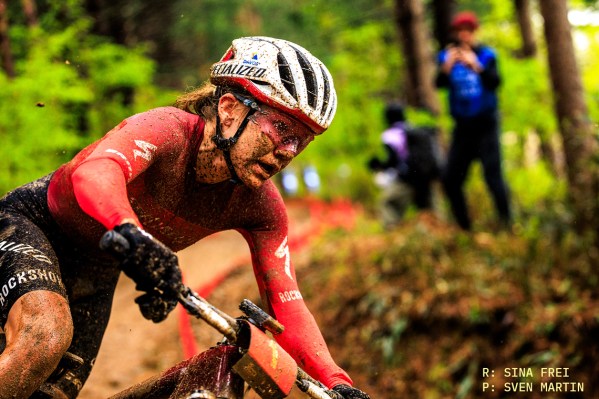
Race day brought constant rain. Not heavy, but enough. The dusty XCO track was turned into what has been collectively agreed upon as the worst conditions on a World Cup track ever. The track didn’t just get wet, it came apart- the fine powder-dry surface rapidly absorbing water and turning into glue-like mud, leaving riders fighting the track as much as each other. An estimated 50% of the time was spent running (or walking), and the general mood was traumatised.
Maybe the only person who had fun was child of cyclocross, Maddigan Munroe, who finished 3rd in the elite women, by far her best ever result. In front of her, Sina Frei backed up her XCC win after a back and forth battle with Jenny Rissveds, decided not from attacks but from who made the fewest mistakes.
In the elite men’s race, Dario Lillo rode off from the first climb to take a very dominating first elite World Cup win. Luca Martin came in second despite a crash early in the race causing some carnage as he took the bunting down with him. Charlie Aldridge finished in third, and, at 25 years of age, was the oldest rider on the podium.
Overall, South Korea felt like quite the misadventure – still and adventure, but a brutal way to start the season. Early May in the Korean mountains always carries rain, and holding a first-time race on a fresh, unsettled track at a location known for it raises questions. However, it is called a World Cup for a reason, and adapting to new venues is all part of the game.
Now racers are back to the very familiar venue of Nové Město in three weeks’ time.