


Words and photos by Joe Delves
What could you achieve if you convinced two per cent of the population to become paying members of your local trail association? In Vermont, USA, the answer is to build an enormous network of more than 1,000 miles of sustainable backcountry trails that crisscross the state and will soon form an unbroken chain connecting it from north to south.
With the European season already closed for the season, the Misspent crew packed our bikes and pedalling legs to join the Vermont Mountain Bike Association for a road trip across the green mountain state. Its largely enthusiast-constructed and lift-free trails promise great riding along with a community-focused approach to land access and trail building which, I pondered, could be a model for projects back home.
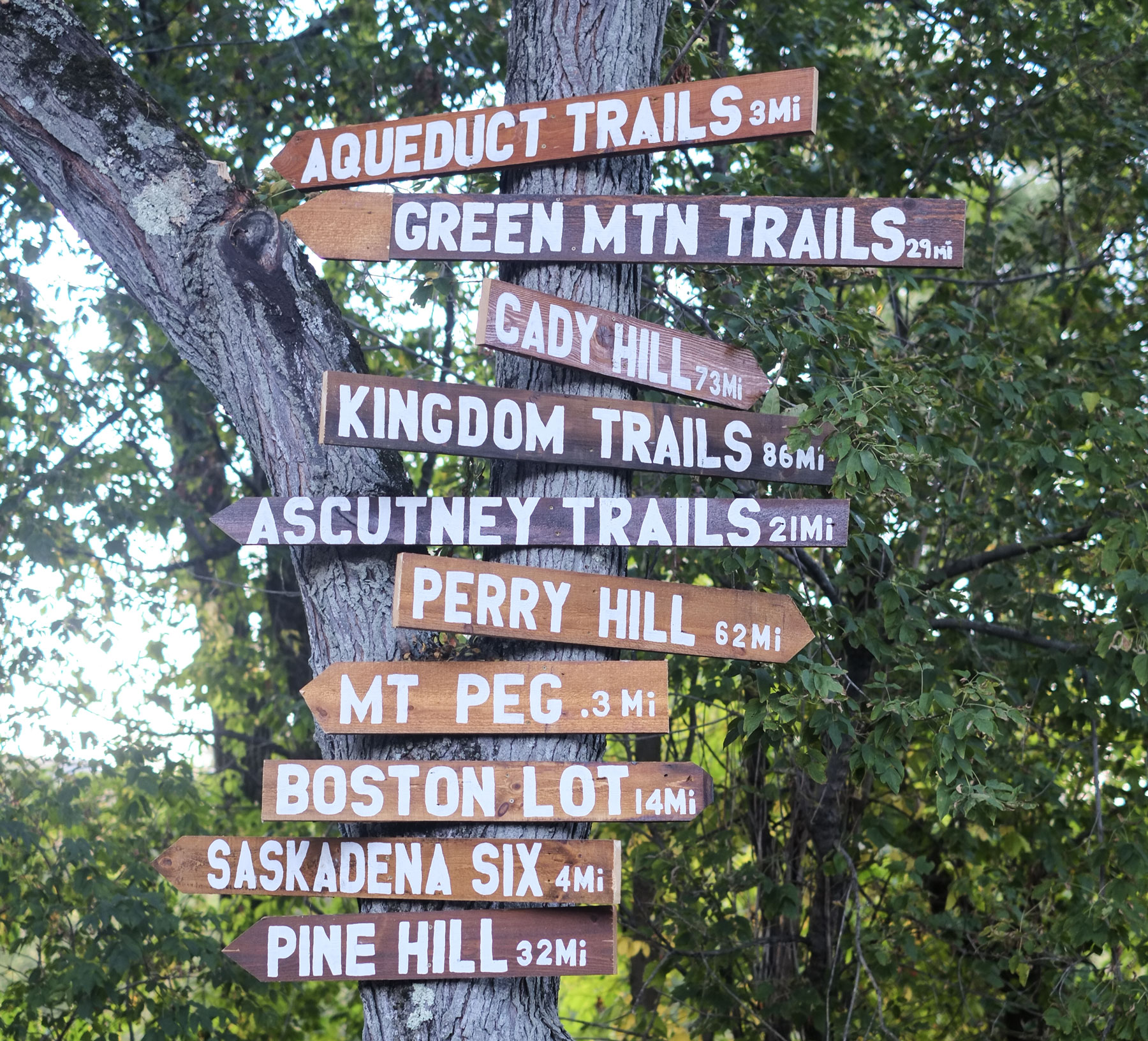
Day 1, Woodstock – Woodstock Area Mountain Bike Association
Like its festival-hosting namesake, Woodstock, Vermont majors on low-key hippy vibes. Its affluent clapboard houses and picturesque main street provide visitors with a refined dose of late fall Americana. Although the valley in which it nestles is lush rather than sheer and rocky, our guide from the Vermont Mountain Bike Association, Joe Gaynor, is quick to reassure us that there’s plenty of riding hidden beneath the autumn leaves shrouding the surrounding hillsides.
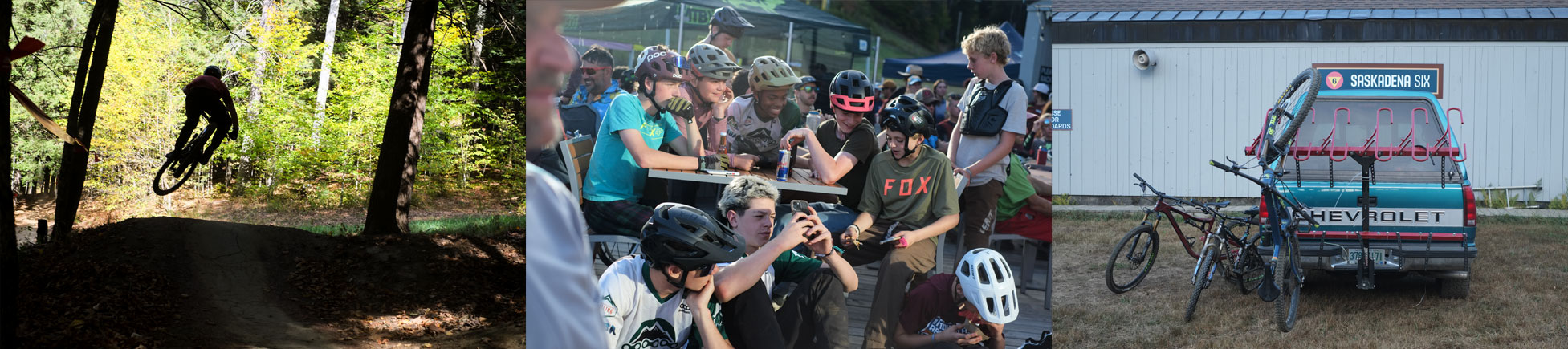
We’ve made it just in time for VMBA’s Season S’ender party which sees a pedal up, race down event at the backcountry Saskadena Six ski area followed by a film night at the local cinema and beers at the recently opened Ranch Camp bar and workshop. However, the day starts with a relaxed ride-out starting just outside of town at the Mount Peg trail network.

Large swathes of Woodstock were owned by the Rockefeller dynasty and are now managed by Woodstock Foundation. The foundation also owns the Woodstock Inn and Resort which has agreed to put us up for two nights. Happily, rather than hoard access for themselves, they’ve allowed VMBA to build almost 30 miles of trails. These free-to-ride routes are extremely popular, as the stream of riders kicking up late-season dust through trees, round berms and down the occasional rock slab attests. Not only does everyone seem to know each other, but the locals are extremely friendly and by the end of the morning I’ve blagged an onward lift to the day’s main event.
On arriving at the pleasingly rickety Saskadena Six ski area I’m slightly surprised to find the lifts aren’t running. Turns out that it’s uneconomical to run them during the summer. Luckily everyone seems happy to pedal up, which teaches me a first lesson about mountain biking in Vermont: people here are fit. Most of the riders smash up and down without e-bike assistance, with some gaining a ton of laps before the prize-giving and general booze-up that rounds out the day and serves as VMBA’s end-of-season send-off.
Day 2, Gifford Woods
Despite the previous evening marking the season’s end, we reckon there’s still plenty of mileage left in the Vermont trail season and the high and warm sun seems to agree. Gifford Woods is just a half hour drive from Woodstock – although more if you make like a trucker and stop for pancakes at Sugar and Spice in Mendon.
The US Forest Service is famously protective of the environment. That doesn’t make it easy to arrange access for mountain biking. The Sherburne trail network is in one of the prettiest bits of the Green Mountain National Forest. In getting permission to build the network it helped that the local VMBA chapter could demonstrate community enthusiasm while calling on its own ecologists to ensure the trails sit lightly in the landscape.
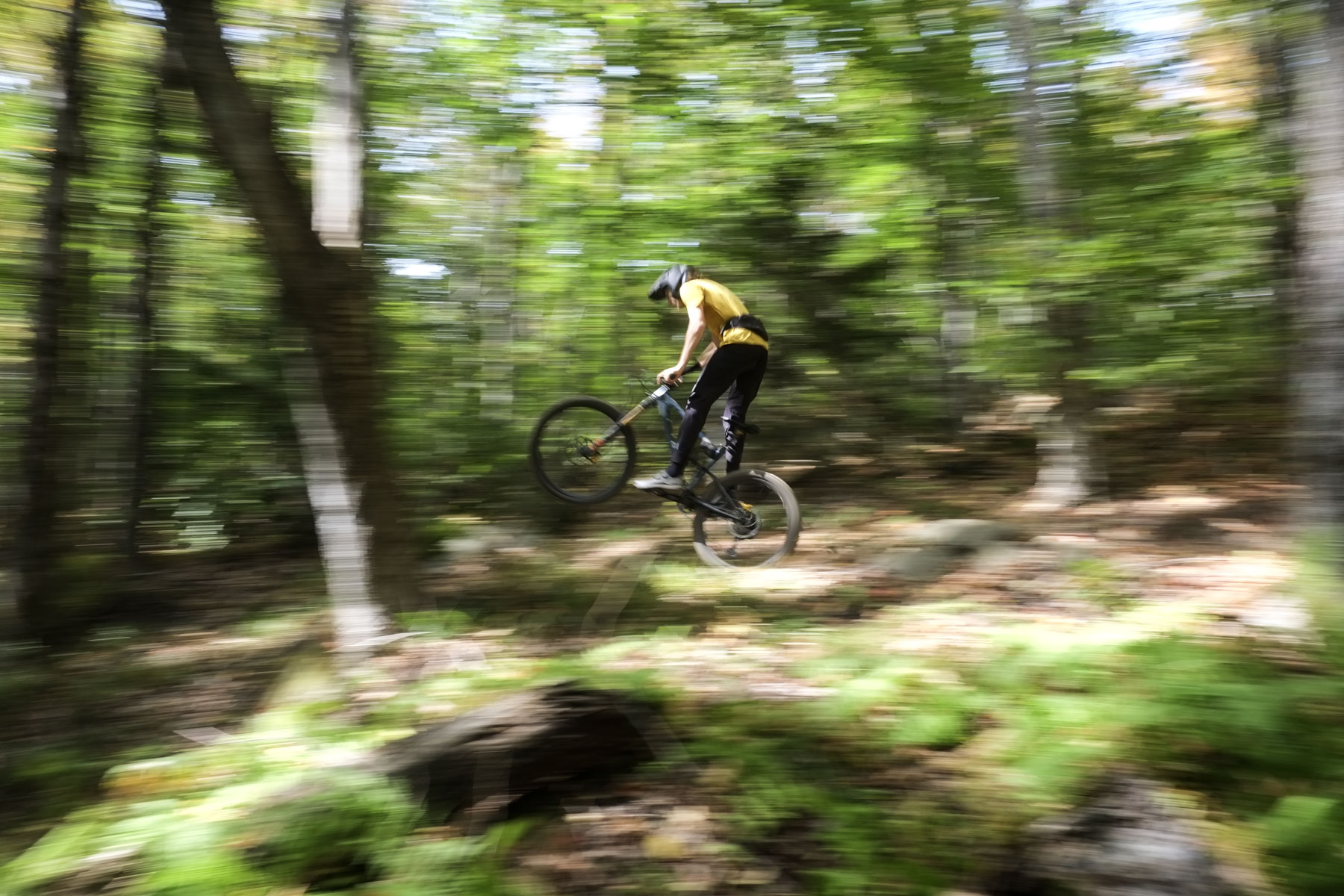
Swooping around the 18 miles of flowy all-weather trails, it’d be easy to miss the enormous amount of work put into their construction. Not only have they been made robust enough that they won’t wear through and need to be rerouted, but significant and now almost invisible mitigation helps ensure that snow melt doesn’t wreck the trails or the surrounding habitats.
The progressive nature of the trails has also been designed with adaptive riders in mind. In fact, an unprecedented 10% of Vermont’s more than 1,000 miles of trails are adaptive-friendly or adaptive-optimised. Despite this, the trails still feel properly wild, to the extent that at one point we convince ourselves that there’s a bear lurking somewhere nearby. On returning to the visitor centre, the woman there confirms that this is indeed a real possibility.

Day 3, Rochester and Randolph – Ridgeline Outdoor Collective
The morning’s less compliant weather doesn’t dissuade us from chucking the bikes in the car and making the quick drive along the Ottauquechee river to more trails and a change of location.
Today’s start point is just behind the Forest Service’s Rochester ranger station, where we find an access road that takes us into the woods and gains us some altitude. Dropping onto the trail we pass a sign cautioning that during winter, maintenance crews from the local snowmobile association might be on the trail at any time, day or night. Luckily, there’s a couple of months left before Vermont’s famously harsh off-season sets in.

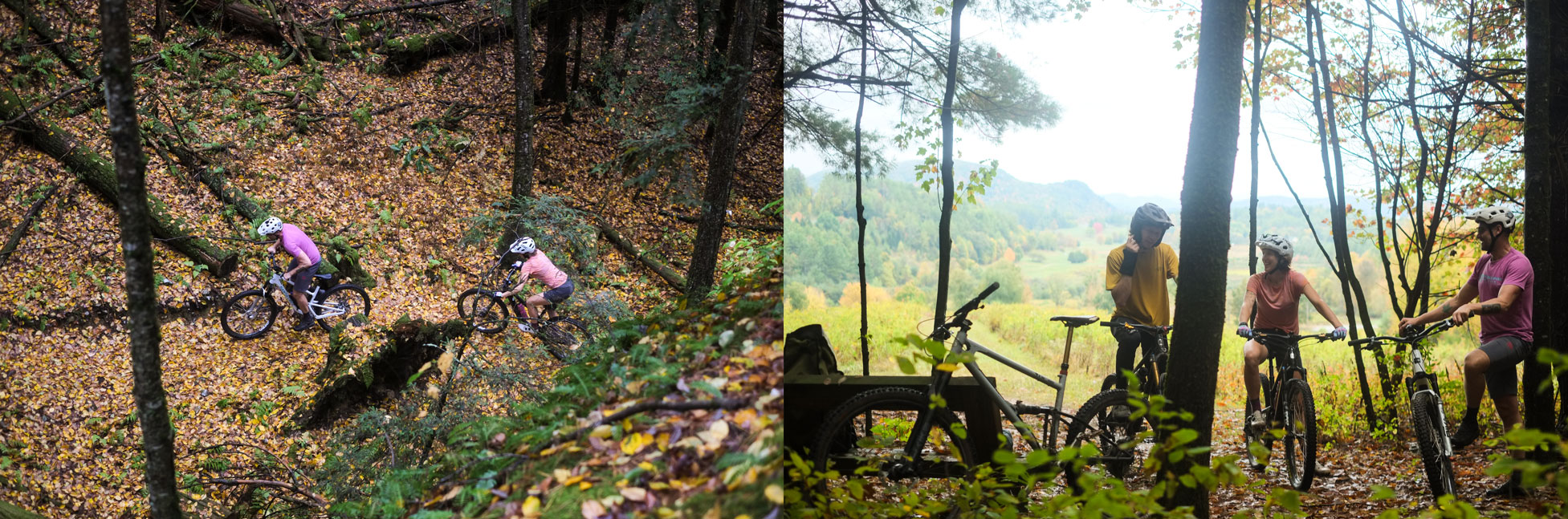
The trails here are initially easy going before becoming more technical with jumps dotted throughout. Soon the landscape also closes in and switches from rocky to incredibly lush and mossy. Halfway around we also get a sneak peek of a new jump line that VMBA have put in with a budget of over $20,000. The trail’s a proper hidden gem and the only way to reach it is by pedalling out. It’s a good indication of the riding you can find in Vermont, which is both backcountry but with enough built features to keep those used to trail centres and lift runs happy.
Along the way, Gaynor points out one of the area’s recently rewilded meadows. In the past, much of Vermont was semi-arable. However, many farms had already become unviable long before hurricane Irene crashed through in 2011. Since then, marginal land on many hillsides has been reverting to a more natural state. At the same time, cycling and hiking are drawing new tourists whose spending can have a positive effect on the economy. It’s part of a state-level plan that VMBA has ensured also considers bikers.
Having spent the morning riding their local trails, that afternoon we swing by Randolph to visit Sean Curran and Angus McKusker at the Ridgeline Outdoor Collective. The pair help run a cycling club for local youngsters. As the kids practice their sprint starts, McKusker explains the area’s unique biking ecosystem. While we were very happy to have spent the morning piggybacking on the hard work of people like McKusker, it’s showing the benefit to local people that really swings things when negotiating land access. The upshot is a long-term benefit to the community and an additional draw for tourists who help support the local economy.

Day 4, Rochester
Our new base of Rochester is pretty much the ideal small Vermont town. If Woodstock is cosy, and perhaps a bit twee, the north of the state feels wilder. While the hills still aren’t huge, the landscape has enough scale that there’s an archetypally American sense of space. Most of the town huddles around the main street. Here you can find the laundromat and a hardware shop selling chainsaw parts and hunting licences. Yet, while people seem self-sufficient, there’s also a great coffee and book shop along with an art gallery, bike shop and the very comfortable Stable Inn lodge. The last three of these are run by Anni and Doon who have agreed to put us up and show us the trails.
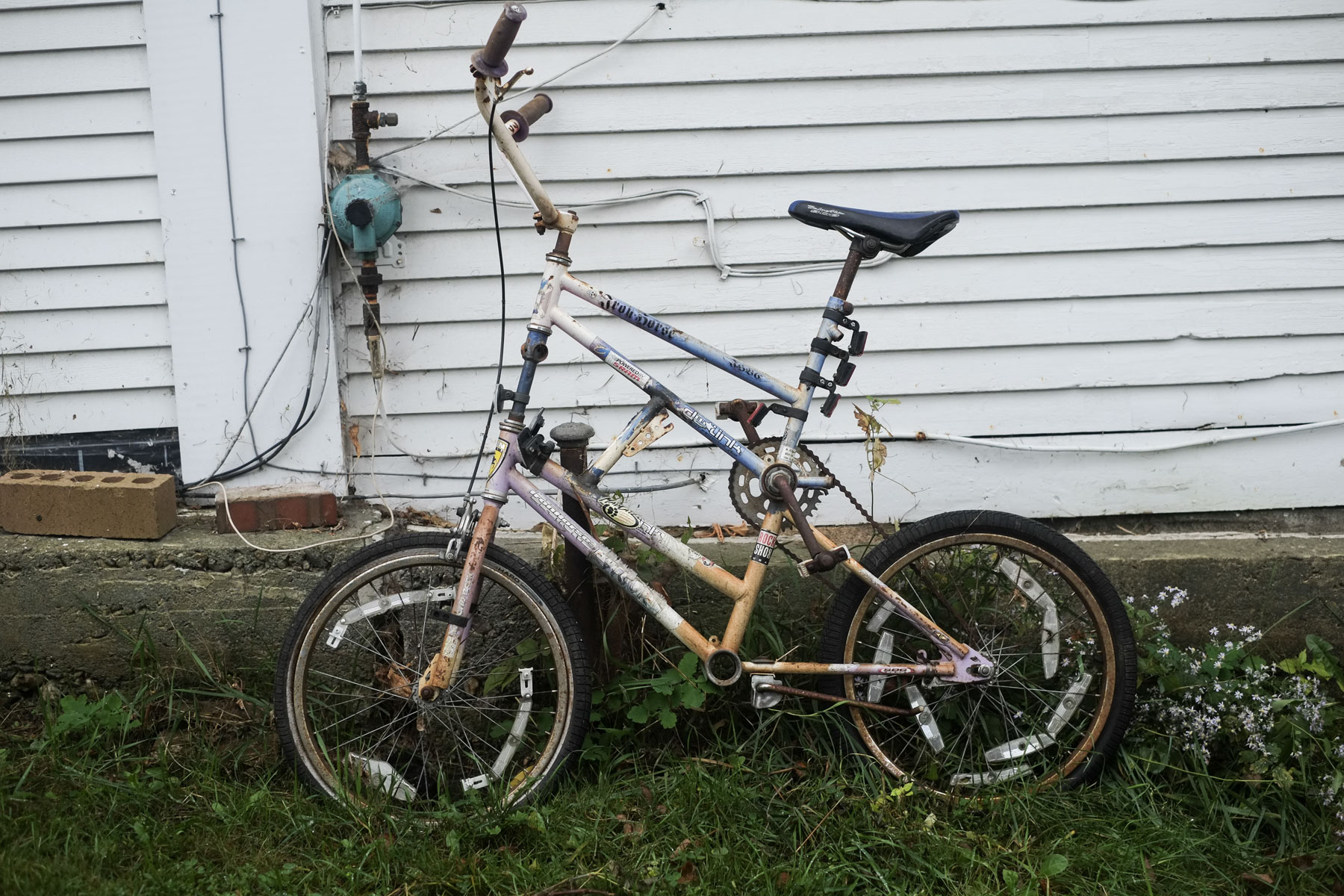
For my money, Doon’s Green Mountain Bikes might be the world’s greatest bike shop. Its four-decade existence has seen parts and memorabilia accumulate in jumbled assemblages. These now dot an outlet that’s more compound than retail space. In one corner several hundred rear derailleurs await scavenging or recycling, while every wall is covered in flyers for bike races and causes both retro and modern. Its workshop can be accessed by the side door, or through a drawbridge that’s cranked open using a mechanism built from salvaged drivetrains.
When Anni and Doon arrived in Rochester almost all the local trails were poached. Now a short drive in their camper brings us to the base of Mount Reader. Ahead of us in the autumn mist are the 110 berms and around 500 metres of elevations that make up the famous Tunnel Ridge trail. The low-key trailhead at the end of a dirt track gives little indication of the enormous effort that went into building it. Whereas most trails will rely on fire roads to gain their elevation, the climb up is as carefully sculpted as the descents. Probably the flowiest trail in the state, it will soon serve as a link in the single trail connecting one end of it to the other. Instead, we loop it together with some wilder local sections to arrive back in Rochester several hours later.
Day 5, Killington
While Vermont’s USP is pedal-accessed backcountry trails, that doesn’t mean it’s devoid of lift bangers if you want a change of pace. The resort of Killington has over 30 miles of trails serviced by three lifts on a hill with 2,000 ft of elevation. Plus, late in the season you’re likely to have both the trails and swimming pool largely to yourself.
Having spent the morning doing lift runs, the second half of the day looks like being rained off. Luckily, there’s still plenty to occupy ourselves with and we roll partway down the mountain to check out practice day at the US Downhill Championship race. The razzmatazz of the event is a counterpoint to the previous days’ more low-key and self-sufficient riding and shows the breadth of riding available in the state.
With the rain hammering down we shelter under a gazebo with long-time Misspent pal Matteo who is wrenching for the GT team. We also manage a quick beer with the eventual winner Dakotah Norton. Now pretty soggy, we load the car and head out to our final stop in Slate Valley.
Day 6, Slate Valley Trails
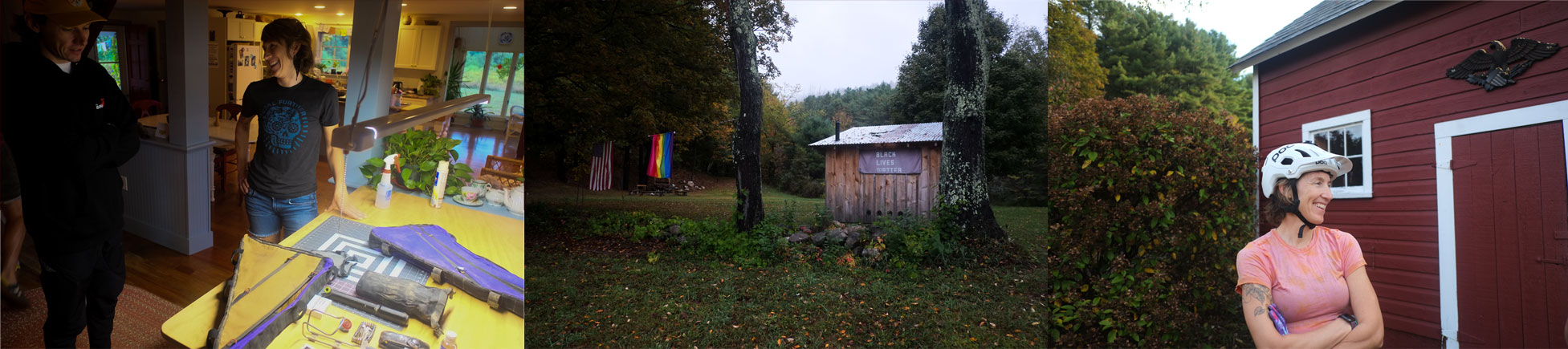
Arriving in the dark and rain, the dead-end road down to the Slate Valley TrailHouse has slight Deliverance vibes. Luckily, its owners, Caitrin and Hardy provide a reassuringly warm welcome. The next day, as morning breaks above the valley, we get a first proper look at the location. The couple’s 1800s farmstead sits on its own right in the middle of the Slate Valley Trails network. In fact, the Carnie and Ringmaster trails run right beside our cabin.
This isn’t entirely a coincidence. Caitrin and Hardy have been instrumental in creating the network, both building the trails and running camps to introduce people to them. Their farmstead and campsite would make the ideal base for looping together big rides from the nearby trails.
Unfortunately, our return flight is booked in the not-too-distant future, so we opt to tour some of the trails immediately surrounding the property. It’s a good opportunity to see the couple’s handiwork, and the ideal thing to use as a morning warm-up, or to tire yourself out if you return after a day’s riding and find yourself with unexpected extra energy.
After riding up the meadow adjacent the farmstead the trail drops straight into the surrounding woodland. More technical than most of the other riding we’ve seen so far, there are plenty of rooty and rocky sections along with the odd jump line squeezed in between the trees, all of which are built with the care and attention of someone building in their local patch.
Oh, Vermont
It’d be easy to spend many weeks in Vermont, but we’ve got to make for the airport. Having racked up under 100 miles in the rental car since we arrived while squeezing in six days of back-to-back riding, we reckon we’ve seen a pretty good slice of Vermont’s trail riding scene – enough to know it’s well worth revisiting. Its sustainable trails and community-first approach are perfect material for a laid-back road trip. At the same time, VMBA and the state’s approach to trail building is also a great template for anyone wondering if they could do something similar where they live.