

See this article and others in Hurly Burly 2021.
Words: Paul Aston || Photo: Boris Beyer
The 2018 season saw relative rookie Amaury Pierron take three World Cup race wins and wrap up the overall series title with a round in hand. Any World Cup winner can ride a bad bike better than you or me, but there are racers riding junk week in, week out and not winning despite their best efforts. What happens if you marry one of the best racers to a sled that matches them perfectly? Reference the opening line of this paragraph.

Let’s dig a little deeper: I spent a lot of time on the Commencal Supreme DH 29 in 2018, and in my eyes it was the downhill bike of the year, maybe even decade. The supreme is massive, has 29-inch wheels, a huge amount of rearward rear-axle travel, a very high-pivot, large amounts of ‘brake jack’, and a really long chain to go around all those sprockets. Pierron is not a giant, but he’s tall enough to ride a size large frame with +5mm reach headset (480mm reach is massive for an L-size).
All the races Pierron won were on long, wide tracks with high top speeds: Fort William, 57.06km/h; Leogang, 57.64km/h; Val Di Sole, 64.76km/h. He didn’t do badly at Vallnord (56.83km/h) or MSA (66.67km/h) either, in second and fourth respectively. He didn’t win on the tight, short and pedally Losini (43.38km/h), but did puncture there. La Bresse (49.53.km/h) was short and he crashed within sight of the finish. Maybe the big rig would have taken those too?
‘But big bikes don’t go around corners!’ That’s utter nonsense. Even if it were true, tight corners are next to non-existent on World Cup tracks nowadays. Even if the long bike did lose him a millisecond on one corner at one race, literally hundreds of high-speed turns and repeated rough sections were smoothed by those big wheels, the high pivot, and lack of pedal kickback. The ‘Magic Carpet’ was the bike’s nickname around the losers’ pits.
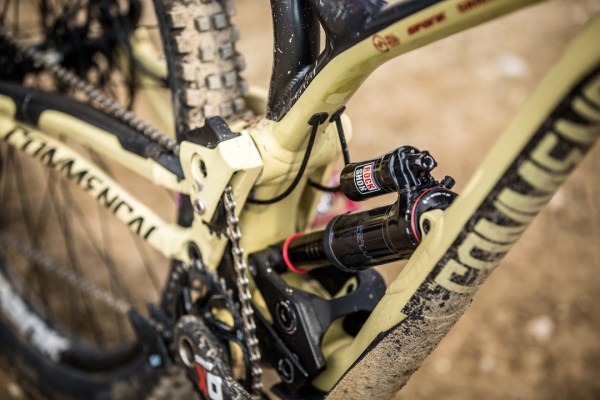
What else could create the perfect marriage between this bike and rider? Maybe anti-rise? What is it? A bike with high anti-rise will make the rear suspension move into its travel when braking and hitting bumps, preserving the geometry of the bike (by countering the weight of the rider shifting forward) but hindering suspension action. Low anti-rise will let the suspension move more freely under braking but the weight of the rider will shift forwards and geometry will be compromised for downhill. Low anti-rise is what many people think they want, avoiding ‘brake jack’ and their suspension not working on bumps (the suspension will actually absorb bumps better, but won’t be able to rebound easily).
I think this perceived negative of high anti-rise could have been a huge benefit to Pierron for several reasons, namely:
- He travels really fast, which forces him to brake really hard. He is fairly tall and heavy (180cm, 80kgs) and a higher centre of gravity at higher speeds means more weight shifts forwards when braking – the high anti-rise will counter this. On the same bike an average John, who is 160cm and 70kgs, riding slowly and dragging his brakes over bumps, will be moaning about his suspension not working.
- Pierron ain’t braking where John is braking.
What else? A bike with high anti-rise without any pedal kickback (the force that makes the cranks rotate anti-clockwise under chain stretch, in this case reduced thanks to the idler wheel) will out-brake a bike with the same level of anti-rise but with high anti-squat (the force preventing pedal ‘bob’) and more pedal kickback.
Then there’s flex and damping. In the constant industry race to make things stiffer so the marketing department has a ‘X% more’ to add to their sales spiel, the Supreme swingarm is one of the most flexy out there. But it is stiff close to the main pivot thanks to its triangulated shape, then it tapers towards the rear axle to nearly nothing. This gives it plenty of flex to track and grip the ground – when you see Pierron’s line choices, it’s something he needs. Mechanical grip from the frame combines with a BoXXer at the helm – a fork that flexes and tracks better than a Fox. Then there’s the big 29″ wheels, these flex more than equivalent smaller hoops and those funky Vibrocore wheels from Spank promise more vertical absorption than others. Add a CushCore tyre insert to help with damping trail vibrations and also benefit from the lesser-noticed earlier activation of the suspension compared to an empty tubeless tyre. The final piece of the grip-pie is the ultra soft Schwalbe tyres that grip incredibly well.

So what does all of this add up to? A bike that is very easy to ride, that builds stability and grip the harder it is pushed, and gives minimal feedback to the rider. If someone with Pierron’s skills, muscles and balls has such an easy ride then he can push harder than anyone else – shown by multiple wins and lines that other racers didn’t even know existed.
At the end of the day, it’s the rider who makes the magic happen. But give a pinner a setup that compliments them on today’s race tracks and you have a winner.
By Paul Aston, independent bike reviewer.
If you enjoy reading this, you should check out the Hurly Burly. It’s got many features like it, plus round-by-round accounts of the UCI Downhill World Cup and pore over hundreds of the best images of the season in Hurly Burly Book.