

I was asked a few months ago what road cycling could learn from downhill mountain biking.
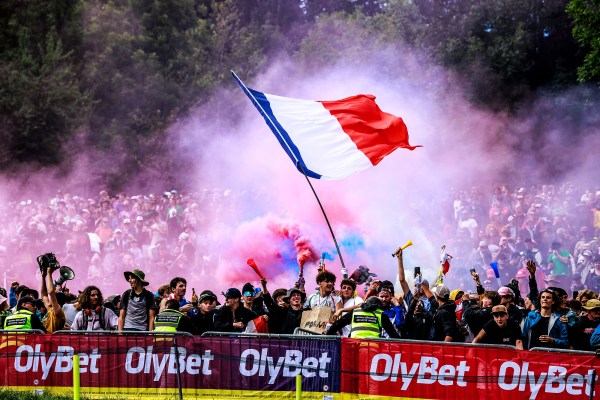
It stumped me, initially. I’d just gotten back from my first European World Cup round with Misspent Summers in Les Gets, buzzing on all the usuals: being surrounded by lovely people; watching some amazing racing with some absolutely bonkers fans; being in the sun (for the most part).
The piece was for a British road cycling website and it was a bit of a flop – because I didn’t really know the answer. And, in hindsight, I think it was an impossible task from the outset. They might both have two wheels, but downhill and road cycling are completely different beasts.
One is about team tactics and watts per kilo, the other about grit and calculated risk. Where professional road riders are household names, downhill athletes remain famous within a microcosm.
Then there’s the money. Tadej Pogačar walked away with €500,000 after winning the Tour de France in July. (As the winner of the Femmes, Pauline Ferrand-Prévot took home just 10% of Pogacar’s prize money.) On the other hand, a downhill rider (male or female) who wins every stop on the tour and the World Championships would earn just €52,500.
But gender pay disparity exists in mountain biking, too. Despite awarding the same prize money to World Cup race winners regardless of gender, 87% of the women surveyed in Pinkbike’s ‘State of the Sport’ report agreed that the gender pay gap in mountain biking is still alive and kicking: of the 61 professional female athletes surveyed, 48% of them earned between $0 and $10,000. Only 27% of male riders fell into this category. The gap widens as riders earn upwards of $100,000, with male riders making up 71.4% of the sport’s top earners.
But the world of mountain biking is rapidly changing. The 2023 Warner Bros. Discovery acquisition ended Red Bull’s free-to-air coverage of the UCI Downhill World Cup, introducing a new qualifying system and a roster of changes aimed at elevating “the sport and reach[ing] a new global audience.” On local trails, the rigid machines used to get through the woods in one piece have, in my town at least, been replaced by teenage boys on heavy-duty downhill bikes. Big money has entered the conversation.
So, the question flips: what can downhill learn from road cycling as the sport grows?
And I think it comes down to the preservation of joy and play, things that feel harder to find in professional road racing.
At the end of the Paris-Nice stage race earlier this week, pro rider Damiano Caruso lamented the lack of playfulness in road cycling: “Ten years ago, it was 70% work and 30% fun,” he said in comments collected by TV2. “Now it is 100% work. I no longer find any playful elements in it.”
But other athletes are finding ways to reintroduce play into their sports. After the Winter Olympics, everyone was talking about Alysa Liu, the 20-year-old American figure skater. She’d retired from ice skating at 16, and returned after having found her love for skating again. This time, it wasn’t about achieving perfectly executed moves in a flawless routine; it was about having fun on the ice, about creating space “for softness and ambition to coexist,” as Marie Claire put it.
During the same Olympic Games, Eileen Gu, the most decorated freestyle skier in Olympic history, told reporters that part of what motivates her to perform is to satisfy her inner child.
“The fact is that I get to become, every single day, the kind of person that me at age eight would revere,” the 22-year-old said in Italy. “I would be obsessed with me today. Are you kidding? I would love me. And I think that’s the biggest flex of all time.”
This new generation of ‘Gen Z’ athletes are reframing what sporting excellence looks like, and it’s grounded both in enjoyment and discipline.
And I think downhill has kept hold of this essential ingredient. Yes, the athletes are disciplined, talented, strong beyond my comprehension, but play is at the heart of the sport. Before any of the athletes we watch race down hills today, they’ve spent years digging tracks in their local woods.
In the latest episode of Downtime Podcast, Tahnée Seagrave tells Chris Hall of the freedom she felt at Hardline: “it’s just me and a bunch of lads and them saying: ‘do it!’ […] and it reminded me of why I started riding in the first place.” Just last week, Laurie Greenland promised to ride a classic Iron Horse Sunday downhill bike at Crankworx Rotorua if his Instagram post racked up a million likes. All after years spent pushing the limits of his safety in pursuit of downhill wins.
Play, of course, lives in road riding too. Even the discipline’s accepted GOAT, Pogačar, posted a reel on Instagram recently, riding on roads, gravel, track and eating pastries like any weekend warrior. One comment says it best: “The best thing about Pogi is that he makes training fun and racing feel like a game.”
Maybe play just looks different, maybe it just becomes harder to hold onto as one moves through the professional ranks, found again in events like Hardline that remind you why you started riding in the first place – or on pastry run rides with your mates.
This has been another fruitless quest to answer an impossible question. But it’s turned up a new one, for me: how do you maintain the essential elements of a sport while investing in its growth, while encouraging the celebrity of the athlete to balloon? How do you keep a core of play while riders risk their safety hurtling downhill at increasingly record-breaking speeds?
I don’t know the answer. I’m a relative newbie to both disciplines, nearly totally unqualified to answer – and yet it feels an urgent question. I guess we’ll see what the season has in store: I’m buckled up.
What do you reckon? Drop me a line: [email protected]